Alien narratives are the modern iteration of ancient folklore, reflecting how human interpretations of unexplained celestial phenomena evolve alongside cultural beliefs. My main argument is that both ancient and modern accounts share a fundamental pattern: presenting mysterious events as responses to the unknown, adapted to contemporary worldviews. But there is more when you approach the question scientifically.
Centuries ago, aerial mysteries were cast through religious eyes, within cosmologies alive with divine forces. What previous eras named “celestial chariots,” “pillars of fire,” or “messengers” (angels) are now reimagined as tech-driven extraterrestrial travelers. This shift suggests that today’s alien may be merely ancient spiritual archetypes resurrected in mechanical guise. Comets, before their astronomical classification, were inked in history as omens—supernatural warnings from above. Stories of Alien Life serve today’s TESCREAL fantasists well, as they imagine themselves becoming Gods of the Universe. For spiritualists, Aliens provide yet more reasons to believe.
H. sapiens are hubristic, credulous, social storytellers with great imaginations and an evolved suite of tools for recording our thoughts and passing them forward. We are also very inquisitive and have developed methods and tools to explore how the world we experience works.
Jacques Vallée, a leading voice, claims alien visitations mirror European fairy tales. In Passport to Magonia, he asserts that the essentials of modern abduction—missing time, food exchanges, parallel realms—have echoed through centuries. Even the medieval “changeling” myth, where spirits snatched children, parallels today’s tales of alien experiments and hybrid offspring.
It is readily acknowledged that our time has surpassed all epochs in history for the accumulation of technical knowledge, physical power over our environment, and economic might. It is less often pointed out, however, that our age has generated, and continues to generate, mythical material almost unparalleled in quantity and quality in the rich records of human imagination.
More precisely, people have very frequently reported the observation of wonderful aerial objects, variously designated as flying saucers, unidentified flying objects (UFOs), and so on; among these narratives descriptions of landings made by these craft are commonplace; and that quite a few accounts purport to inform us of the physical characteristics, the psychological behaviour, and the motivation of their occupants. But investigators have neglected to recognize one important perspective of the phenomenon: the fact that beliefs identical to those held today have recurred throughout recorded history and under forms best adapted to the believer’s country, race, and social regime. If we take a wide sample of this historical material, we find that it is organized around one central theme: visitation by an aerial people from one or more remote, legendary countries. The names and attributes vary, but the main idea clearly does not. Magonia, heaven, hell, Elfland - all such places have in common one characteristic: we are unable to reach them alive, except on very special occasions. Emissaries from these supernatural abodes come to earth, sometimes under human form and sometimes as monsters. They perform wonders. They serve man or fight him. They influence civilizations through mystical revelation. They seduce earth women, and the few heroes who dare seek their friendship find the girls from Elfland endowed with desires that betray a carnal, rather than purely aerial, nature.These matters are the subject of Passport to Magonia, Jacques Vallee’s seminal master-work that changed our understanding of the UFO phenomenon. An instant classic when first published in 1969, the book remains a must-have resource for anybody interested in the topics of UFOs and alien contact, as well as those fascinated by fairy folklore and other paranormal encounters.
Carl Jung, a psychologist, saw this transition as a direct answer to technological anxiety. He dubbed UFOs “visionary rumors” and “modern myths,” arguing that as formal religion receded, humankind’s hunger for transcendence and saviors remained. That need was projected skyward, where saucers emerged as technological mandalas—symbols of hope and order for an age threatened by nuclear annihilation.
Although the vocabulary has shifted from spiritual to mechanical, the human drive to explain the unknown remains unchanged. The “alien” is simply the latest mask for a timeless human response to mystery.
An Anthropic Mirage
The widespread interest in extraterrestrial life reflects deep connections among cognitive psychology, evolutionary biology, and theoretical physics. I think that human fascination with alien visitation, recently fueled by the release of UAP records from the United States Department of Defense and AARO, arises from cognitive tendencies to seek peers beyond Earth. Despite the lack of empirical evidence, such narratives endure, amplifying tensions between scientific consensus and popular folklore. I want to explore how this excitement persists and relates to contemporary scientific misinformation.
Why Humans Seek the Stars
The excitement around alien visitation stems from the human need to construct meaningful explanations for ambiguous phenomena. Psychologists analyze beliefs in UAPs through intuitive and conspiratorial information processing. Primary experiences, known as agency detection, reflect how people instinctively interpret ambiguous stimuli as evidence of agents or threats—for example, a pilot perceiving a flicker of light as a craft rather than an atmospheric effect.
Secondary experiences are shaped through social and conspiratorial frameworks, further extending the meaning-making process. Media reports can lead to convictions about cover-ups or extraterrestrial presence. Psychological concepts such as apophenia and pareidolia explain how people form narratives and see patterns. Research shows those who report alien contact may be more prone to absorption and vivid fantasy, suggesting porous boundaries between imagination and perceived reality—highlighting the mind’s role in creating meaning.
The conversation I am highlighting below this paragraph, between Jim Rutt and Jordan Hall, is not about aliens; it is a deep exploration of rationalizations and logic, more concerned with meaning-making and questions of the immortal soul. You might find it an interesting listen, or it may do your head in. I put it here to emphasize the importance people place on questions about ontology, epistemology, meaning, and our seemingly temporal nature.
The drive to believe in extraterrestrial companions also reflects an existential desire for meaning and security. Communicators in science, philosophy, and psychology note that discomfort with the unknown leads individuals to fill gaps with imagined entities. Anthropomorphic bias reduces existential dread by projecting human traits onto aliens, creating a mirror for our own significance. This need to find meaning in the cosmos ties back to why people are drawn to beliefs about alien visitation.
Statistical Probabilities and the Drake Equation: N=1 vs. The Great Silence
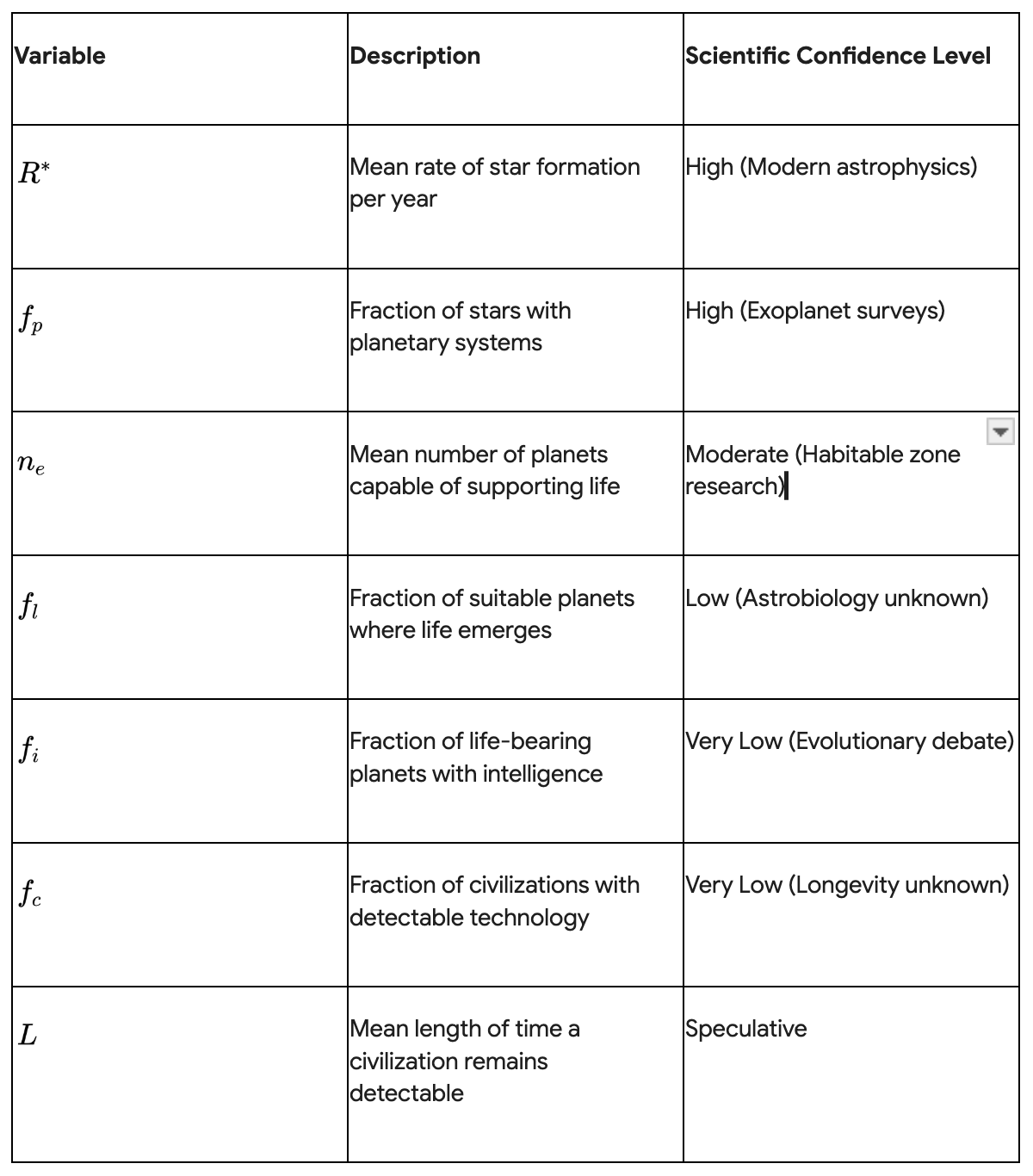
Have you ever wondered why so many scientists think aliens probably exist? While the public is fascinated, the real answer lies in reasoning that goes beyond pure speculation. Scientists use exciting probabilistic tools, such as the Drake Equation, developed by Frank Drake in 1961, to estimate how many civilizations might be out there in the Milky Way. This formula seeks to estimate the number of communicative civilizations
in the Milky Way by multiplying several factors:
Together, these factors illustrate why scientists consider the existence of alien civilizations plausible, even though direct evidence remains elusive.
While we now know that planets are ubiquitous,
The biological variables,
remain the “Great Unknowns.” Modern interpretations of the Drake Equation often suggest that if it
is a small number; it is likely due to the rarity of intelligence
or the short lifespan of technological societies.
Brian Cox has argued that while microbial life may be common, the transition from simple life to a technological civilization requires nearly four billion years—a significant fraction of the age of the universe—making beings like us “extremely rare.” If the probability of intelligent life is low enough that only one civilization emerges per galaxy, then for all practical purposes, we are alone.
This leads directly to the Fermi Paradox: if the universe is statistically full of possibilities, “Where is everybody?” The silence suggests that either we are the first to reach this stage, or that technological civilizations inevitably encounter a “Great Filter”—a catastrophic event such as nuclear war, climate collapse, or resource exhaustion—that prevents them from becoming interstellar.
Convergence vs. Contingency in Evolutionary Logic
To weigh the chances of alien visits, we must ask whether intelligent life elsewhere would develop traits such as human thinking, tool use, and social skills. This question shapes a core debate: some, who lean towards Stephen Jay Gould, say these traits are only human, while others, like Simon Conway Morris, believe similar traits could appear elsewhere. How we answer this debate affects how much we expect alien intelligence to resemble ours.
In this learned romp of science writing, Cambridge professor Simon Conway Morris cheerfully challenges six assumptions—what he calls ‘myths’—that too often pass as unquestioned truths amongst the evolutionary orthodox.
His convivial tour begins with the idea that evolution is boundless in the kinds of biological systems it can produce. Not true, he says. The process is highly circumscribed and delimited. Nor is it random. This popular notion holds that evolution proceeds blindly, with no endgame. But Conway Morris suggests otherwise, pointing to evidence that the processes of evolution are “seeded with inevitabilities.”
If that is so, then what about mass extinctions? Don’t they steer the development of life in radically new directions? Rather the reverse, claims Conway Morris. Such cataclysms accelerate evolutionary developments that were going to happen anyway. And what about that other evolutionary canard: the “missing link”? There is plenty to choose from in the fossil record, but persistently overlooked is that in any group, there is not one but a phalanx of “missing links.” Once again, we under-score the near-inevitability of evolutionary outcomes.
Turning from fossils to minds, Conway Morris critically examines the popular tenet that the intelligence of humans and animals are the same thing, a difference of degree, not kind. A closer scrutiny of our minds shows that, in reality, an unbridgeable gulf separates us from even the chimpanzees, so begging questions of consciousness and Mind.
Finally, Conway Morris tackles the question of extraterrestrials. Undoubtedly, the size and scale of the universe suggest that alien life must exist somewhere beyond Earth and our tiny siloed solar system? After all, evolutionary convergence more than hints that human-like forms are universal. But Dr. Conway Morris has serious doubts. The famous Fermi Paradox (“Where are they?”) appears to hold: Alone in the cosmos—and unique, but not quite in the way one might expect.
Evolutionary Contingency: The Non-Prevalence of Humanoids
Gould argues that evolution is shaped by random events, making its course highly unpredictable. If we replayed the “tape of life,” humanoids would almost certainly not reappear. Biologists such as G.G. Simpson highlight that humans arose from an unlikely sequence of accidents and cite Dollo’s Law, which states that evolution is irreversible—lost complex traits cannot return exactly to their former state.
Biologists also challenge the idea that intelligence naturally leads to technology. The octopus has a large brain and problem-solving skills, but has not developed high-tech tools after millions of years. A high Encephalization Quotient is necessary for technology, but clearly not sufficient. The rarity of technological species implies the intelligence niche is not an inevitable outcome of evolution.
AI Overview
The encephalization quotient (EQ) is a measure of relative brain size, calculated as the ratio between an animal’s observed brain mass and its predicted brain mass based on body size, typically used as a proxy for intelligence. Unlike raw brain-to-body ratios, EQ accounts for allometric effects, revealing how much larger a brain is than expected for a given body size, with humans having the highest EQ at roughly 7.5. [1, 2, 3]
Key Aspects of EQ:
Definition: EQ is defined as \(EQ = \frac{\text{Observed Brain Mass}}{\text{Predicted Brain Mass}}\).
Interpretation: An EQ of 1 means the brain is as expected; EQ > 1 means a larger brain than typical; EQ < 1 means a smaller one.
Limitations: It is often considered an estimate of cognitive ability, but it is not a perfect measure of intelligence and can be misleading across different orders, as bigger species can have lower EQs.
Commonality: While often applied to mammals, research has shown that absolute brain size may sometimes be a better predictor of cognitive ability in primates than EQ. [1, 2, 3, 4]
Origin: Proposed by Harry Jerison in 1973 to represent relative brain size across species, specifically for studying evolutionary trends.
Critiques: Modern researchers argue that the EQ approach is flawed because it assumes cognitive performance does not correlate with body size, and it can unfairly favor small animals, which naturally tend to have larger relative brains.
Alternatives: Newer studies suggest using “cognitive equivalence” or absolute brain size, as they may better predict cognitive performance. [1, 2, 3, 4]
Evolutionary Convergence: The Argument for Determinism
Simon Conway Morris contends that evolution is deterministic, shaped by universal physical and chemical laws. Convergent evolution—such as unrelated species developing similar traits like wings—implies finite solutions to survival challenges. If life exists elsewhere, it may independently evolve similar sensory organs, locomotion, and cognitive architectures because these are optimal for interacting with a physical environment.
Even if convergence leads to similar traits, it does not guarantee “human-like” aliens. Biologists note similarities between dolphins and humans, such as high E.Q., which are often due to inherited genetic switches from a common ancestor, not universal laws. Without this shared biological history, alien life may be fundamentally unrecognizable to us as intelligent or even as life.
Relativistic Physics and the Energetic Barriers to Visitation
To address whether aliens could actually travel to Earth, as discussed by Brian Cox and Neil deGrasse Tyson, we must consider the formidable constraints imposed by special relativity. These constraints serve as a nearly absolute barrier to interstellar visitation by biological beings.
The Cosmic Speed Limit and Time Dilation
Einstein’s relativity says that as something gets faster and closer to the speed of light, it needs more and more energy, and would need an infinite amount to actually reach that speed.
For travelers who are living, this leads to a severe time gap. For example, a ship moving at light speed could reach the Andromeda Galaxy in what feels like a minute, but 2.5 million years would pass on their home planet. Staying in touch or returning is blocked by these time differences, so any civilization visiting Earth would lose contact with its own history and people forever.
The Energy Problem
In summary, relativistic constraints and immense energy requirements make the prospect of biological alien travel to Earth unfeasible, resulting in permanent separation from their civilization and history. The relationship Jordan Hall (mentioned earlier) alludes to is squashed by spacetime, although he doesn’t view it that way.
For instance, propelling a 1,000 kg probe to 20% of light speed requires roughly
joules—equivalent to the entire yearly energy consumption of the United States. For a craft large enough to carry a crew, the energy required would exceed the total output of a planetary civilization. While speculative ideas such as warp drives and wormholes exist in theoretical physics, they require “negative energy” or conditions never observed in reality and are currently relegated to science fiction.
The UAP Files and the Absence of Evidence
The release of U.S. government files has fueled misconceptions about alien visitation. Yet, both AARO and NASA’s reports make clear there is no extraordinary evidence supporting these claims.
Prosaic Explanations and Sensor Artifacts
AARO, by 2024, reviewed over 1,600 cases—nearly all resolved as mundane objects. Reports of “unusual flight characteristics” are often linked to parallax, sensor glitches, or optical illusions, underscoring the lack of extraordinary evidence.
Sean Kirkpatrick, former AARO director, asserts that none of the observed data violates the laws of physics. Cases labeled “unidentified” mostly stem from poor sensor data, not from evidence suggesting alien technology.
The High Bar for Physical Proof
Carl Sagan’s criteria for proof of visitation remain the gold standard in the scientific community. To be taken seriously, one requires physical evidence that can be examined by skeptical scientists. This includes:
Isotopic Ratios: Materials with isotopic signatures not found on Earth or in our solar system.
Island of Stability Elements: The discovery of heavy, stable elements that do not exist naturally on Earth.
Bizarre Physical Properties: Materials with conductivity or ductility that cannot be manufactured using terrestrial techniques.
To date, none of the “alien files” or anecdotal reports have produced such evidence. Crop circles and “implants” have repeatedly been debunked as hoaxes or terrestrial biological material.
Sociology of Conspiracy: Why Stories Trump Science
Comparing mRNA vaccine misinformation to alien visitation narratives is highly relevant to the study of alien visitation narratives. Both phenomena demonstrate how stories can be more persuasive than robust scientific consensus.
The Power of Narrative over Data
Science seeks broad patterns and general truths, but human minds are wired for narrative—the interplay of character, causality, and temporality. A single vivid anecdote, such as one about a vaccine side effect or an alien abduction, leaves a deeper emotional impact than vast datasets. Narrative delivers a subjective telling that helps individuals interpret a complex world, often more memorably and persuasively than facts alone.
The Conspiracy Mindset
Research indicates that belief in alien visitation and vaccine hesitancy are often driven by the same “conspiracy mindset.” This mindset is characterized by:
Mistrust of Epistemic Authority: A rejection of scientists, governments, and institutional “experts.”
Epistemic and Social Motives: The desire to feel unique or to belong to a group that has “unlocked the secret.”
Culture of Suspicion: Fuelled by real past government deceptions (e.g., Watergate), leading to the assumption that all official statements are lies.
This mindset creates a “knowledge deficit” that is difficult to correct with facts alone. For a person with a strong conspiracy mindset, the lack of evidence for aliens is simply further proof of how effective the government cover-up is.
Defining Life and the Limits of Our Vision
Our tendency to anthropomorphize aliens arises from limited definitions of life and consciousness. By defining life solely as “a self-sustaining chemical system capable of Darwinian evolution,” we risk overlooking forms of life that may exist on other timescales or use unfamiliar biochemistries, ultimately restricting our understanding and detection of extraterrestrial possibilities.
Beyond Carbon Bias
While carbon is the most abundant and versatile element for life, scientists have considered alternatives, such as silicon. Yet, carbon’s cosmic abundance is five to ten times greater, and it is chemically more reactive than silicon. This suggests that our focus on carbon may be too narrow; emerging machine learning research targets “molecular organization” rather than specific chemicals, broadening our approach to identifying potential life.
Panspermia and Panpsychism: Speculation without Evidence
Concepts like panspermia and panpsychism are often invoked to explain the origins of life, but these ideas merely shift the problem and lack scientific testability. Panspermia does not explain life’s emergence—only its movement. Panpsychism is a philosophical framework without empirical evidence. Such ideas bridge science and mysticism, yet fall short of scientific consensus.
The Paradox of Our Loneliness
The scientific assessment of alien visitation underscores humility. Though the universe likely harbors life, physics and biology make visitation to Earth improbable. Humans’ excitement about aliens is a psychological coping mechanism—a search for meaning amid cosmic silence.
The government’s “alien files” reinforce what science has established: unexplained phenomena in the sky are almost always terrestrial or atmospheric in origin. The real issue is the divide between scientific consensus—visitation is unlikely—and public belief—visitation is ongoing and hidden. This is a sociological, not scientific, challenge, similar to vaccine misinformation, which thrives because simple stories overshadow complex scientific evidence.
To understand our place in the universe, we must move beyond anthropomorphic assumptions and rigorously define evidence for life—unique isotopic ratios, non-terrestrial biochemistries, and recognizable technosignatures. Until we obtain such data, we must embrace ambiguity: we may be a fleeting moment in the cosmic timeline, but our pursuit of answers makes us integral to the cosmos. The universe’s silence is not absence, but a challenge to expand our definitions of life, intelligence, and reality.
And, of course, one can believe whatever they like.
The Encephalization Quotient and the Illusion of Evolutionary Progress
The debate over extraterrestrial intelligence often centers on the “Encephalization Quotient” (E.Q.), which some view as evidence for inevitable intelligence. Convergentists cite the rise of high E.Q. across diverse lineages as support for this view. However, a closer biological analysis challenges the assumption that high E.Q. leads to technological civilization.
Biologists like Charles Lineweaver use the “Nasalization Quotient” (N.Q.) analogy to show that trends, such as longer noses in the ancestors of elephants, do not imply universal superiority. We perceive high E.Q. as a trend only because humans possess it; this is selection bias. Intelligence is not a universal goal, but one of many specialized survival strategies, like an elephant’s trunk or a cheetah’s speed.
The “Planet of the Apes” idea—that intelligence would quickly re-emerge if humans disappeared—is contradicted by the fossil record. Most life has been microbial for billions of years. Multicellular organisms and high-tech intelligence are rare exceptions. If intelligence were a convergent attractor, it would have evolved repeatedly. Instead, plants and fungi have no tendency to develop nervous systems or technology.
Thermodynamic Constraints on Interstellar Civilizations
If an extraterrestrial civilization could overcome relativistic barriers to interstellar travel, it would likely harness vast amounts of energy, likely as a “Type II” or “Type III” civilization on the Kardashev scale. I’m always talking about Dyson Spheres. According to thermodynamic principles, the “waste heat” from such massive energy consumption should be observable in the infrared spectrum. However, surveys have found no such infrared signatures in thousands of galaxies, directly intensifying the Fermi Paradox by challenging the likelihood of advanced civilizations.
The “Great Filter” may represent a sequence of thermodynamic hurdles. Civilizations must advance through energy transitions—from fossil fuels (Type 0) to planetary (Type I) and ultimately to stellar (Type II) sources—without destroying their own habitat. The absence of Type III civilizations implies a fundamental limitation: either interstellar travel is physically impossible, or civilizations do not survive the transition, suggesting the relevant parameter in the Drake Equation remains small.
The Sociology of “Disclosure” and the Limits of Government Secrecy
The widespread belief that the government is hiding the truth relies on the assumption of unmatched bureaucratic skill and international alliance. With millions of employees and contractors over the years of changing leadership, keeping a secret such as “alien contact” for eighty years without physical evidence surfacing is highly unlikely. This statistic casts doubt on the plausibility of long-term government secrecy.
Sean Kirkpatrick’s comments emphasize that supposed alien evidence is actually a product of Air Force “hazing” and deliberate deception to obscure defense programs. In a “culture of suspicion,” human-created secrets are confused for extraterrestrial ones. Pilots who observe unexplained UAPs often encounter classified drones or new military platforms, not alien technology. Government silence aims to safeguard national security, not to conceal alien contact.
Final Summary of Evidence and Likelihood
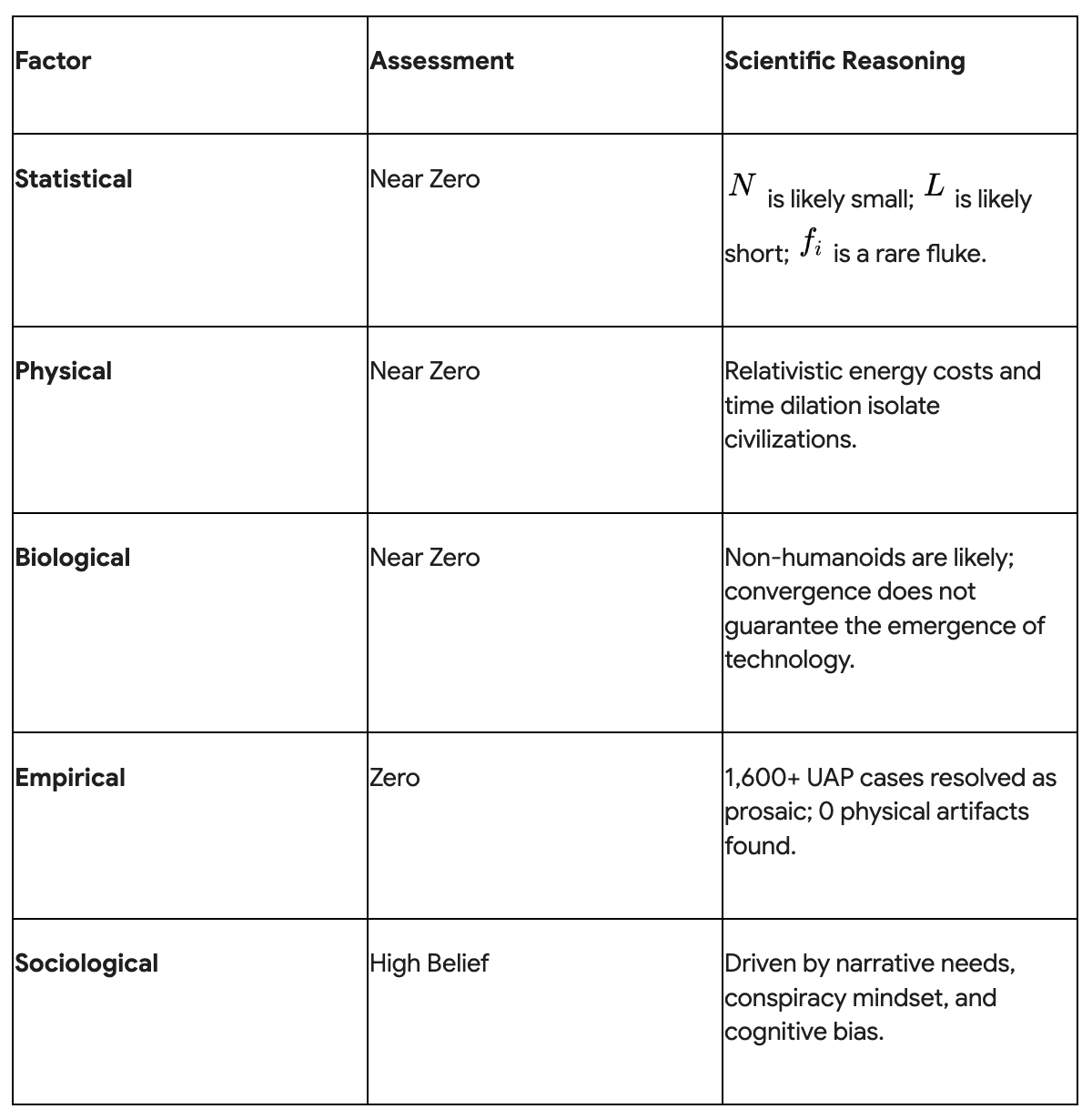
Based on hard science, the likelihood of extraterrestrial visitation to Earth is assessed as follows:
The fascination with aliens reflects our own search for meaning, potential, and connection. As we look to the stars, our guiding principle must be scientific skepticism and the demand for extraordinary evidence. In the vast universe, even though our understanding may be limited, we must not rely on mysticism and conspiracy theories. Instead, disciplined scientific exploration is the path forward.
I do not reject mysticism, beliefs, or stories. I value many ways of exploring existence: meditation, philosophy, science, phenomenology, theology, theosophy, epistemology, and more. Crucially, I distinguish between using science to understand material phenomena and using philosophy or mysticism to explore ontological or existential questions. Both approaches reveal unique insights into this vast universe.
Phenomenology
AI Overview
Phenomenology is the study of structures of consciousness as experienced from the first-person point of view. It focuses on how individuals experience and interpret the world, aiming to describe the “lived experience” and the meaning things have in our conscious life, rather than objective, scientific facts. [1, 2, 3, 4]
Key Aspects of Phenomenology:
Study of Phenomena: It explores how things appear to us, or the ways we experience things.
Subjective Experience: It concentrates on the first-person perspective rather than external or objective reality.
Intentionality: A central feature is that consciousness is always directed toward something (e.g., thinking about a memory, seeing a tree).
Bracketing (Epoché): Phenomenologists often “bracket” or set aside their assumptions and prejudices about the external world to focus entirely on the raw, lived experience. [1, 2, 3, 4, 5]
Origins and Usage:
Founders: The movement was founded in the early 20th century by Edmund Husserl and later developed by thinkers like Martin Heidegger and Jean-Paul Sartre.
Applications: Beyond philosophy, it is used as a research method in psychology, nursing, education, and sociology to understand the subjective experiences of people. [1, 2, 3, 4, 5]
It is distinct from other branches of philosophy, such as ontology (study of being) or epistemology (study of knowledge). [1]
Enjoy your exploration of yourselves, great nature, and the universe. Cheers!